
I’ve already posted about two major parts of Valencia’s annual spring festival: the exuberant noise-making and the fabulous artistic creations of the fallas (giant sculptures) themselves. B ut there are other elements to impress visitors as well.
On March 17th and 18th, it seems like all 800,000 Valencians dress up in traditional native costumes and parade through the city streets.
The women and girls carry bouquets of red or white flowers, whi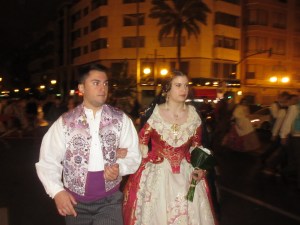 le some of the men wheel or carry huge floral arrangements. And by huge, I’m talking 6 or 7 feet wide and of a similar height.
Each neighborhood group winds its way to the Plaza of the Virgin, where the bouquets are used to form the robes of an enormous statue of the Virgin Mary and baby Jesus. The first group enters the plaza at about 3 PM each day. The last doesn’t arrive until well after midnight.
 Just getting the flowers placed is a ballet. Each bouquet is handed off to a helper who piles them by the side of the giant wooden structure. From there another helper tosses the bouquets to someone else, standing on a narrow ledge b
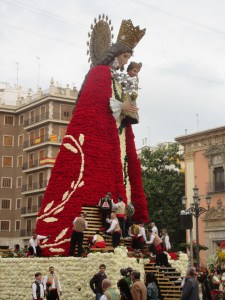 uilt into the statue 8 to 10 feet off the ground. That person tosses the flowers up to someone clinging to the wooden struts near the top of the statue. And he hands them to someone even higher up who wedges them into the structure, carefully following an elaborate red and white pattern that’s different each year.
Nearly all of these helpers are male, though a few young women, clad in traditional men’s short pants and embroidered vests could be spotted. One young lady was having trouble tossing the bouquets high enough to reach her colleague, and I was heartened to find that the crowd was encouraging rather than disparaging. She eventually got the hang of it.
 Meanwhile, the huge arrangements are massed together to the side and in front of the adjacent Bishops’ Palace. By the time all the flowers are in place on the 18th, the blocks surrounding the plaza are perfumed with their scent.
Across town, crowds gather every night on the sides of the old riverbed that now forms a miles-long public park curving around the ancient part of the city. For four nights in a row, the city sets off a spectacular fireworks display. On day 1, it starts at a relatively reasonable hour of midnight. By day 4, the show doesn’t begin until 2AM. I’m not sure anyone sleeps at all during Las Fallas.

The fireworks themselves aren’t much different than those in New York or Washington or Boston on the Fourth of July. There’s the usual assortment of sparkly golden spheres, silver showers and colorful bursts. What is different here is the number of fireworks the y set off at the same time. There are times when you can see only a blur of light, there are so many going off at once. The Spanish also seem to like to set off rows of rockets that streak color from the ground up—sometimes crisscrossing in mid air—while simultaneously huge blossoms appear overhead. It’s a wonderful sort of chaos.
And finally there’s the light displays in the Ruzafa neighborhood. Traditionally, each neighborhood strings decorative lights across their narrow streets, marking their territory with a distinctive design. Most of them are qute pretty and quite tasteful. But the Ca lle Cuba and Calle Sueco are really something. Remember that Danny DeVito movie about the guy whose Christmas lights could be seen from space? He had nothing on the Ruzafa guys.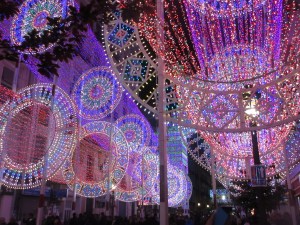
From a 100 feet away, one display looked like some sort of neon cathedral, soaring into the sky. It wasn’t until I was practically underneath it, that I realized it wasn’t just a two-dimensional lighted outline. It was a block-long canopy of coordinated lights. That was amazing enough, but when they started blasting the music and the lights began a syncopated dance, the crowd roared. Me, too.

 nner of holy business fill the next seven days. In Valencia, the highlight of Santa Semaña is the procession on Saturday evening, when the men, women and children of scores of religious fraternities march through the ramshackle maritime district of El Cabanyal. There’s a sameness to much of the procession, which was not yet finished when I and fellow American visitors Gerry and Dennis called it quits after more than four hours. But the colorful costumes and exotic religious nature of the event easily holds the attention of someone like me, whose religious upbringing might best be described as half-hearted. As children, my siblings and I were trotted off to my mother’s Methodist church on most Sundays, but her enthusiasm for organizing and enforcing our attendance waned as we grew older, and my father’s lapsed Catholicism did nothing to bolster it. Most of what I know today about the Bible and early Christianity comes from movies and novels – entertaining but not entirely reliable sources. So I was glad to have Gerry, a graduate of a parochial school education and product of a dyed-in-the-wool Irish Catholic family, as my guide to the various Bibical characters and saints marching by us.
  Salome—yes, she of the seven veils—was easily recognizable and clearly the prize role for the neighborhood sexpot. Though the Biblical Salome would have been a teenager when she danced for her stepfather King Herod and demanded the death of John the Baptist in return, the Salomes we saw ranged in age from a prepubescent 10-year-old to a siren well past the likely age of Salome’s mother. All, however, strutted their stu
 ff imperiously, uniformly posing with hand on hip and a haughty sneer on their faces. The Herods, the legions of Roman soldiers and the occasional Jesus were also easy to identify. Ditto, the personage Gerry refers to as the BVM—Blessed Virgin Mary, for those of us who did
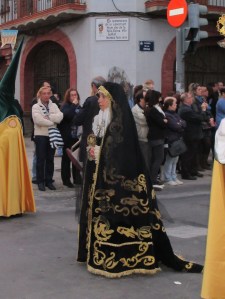 n’t have the benefit of a nun-led education.. There seemed to be multiple incarnations of her—one with a crown of thorns and another who clearly took pride of place in each fraternity’s group: of marchers.This Mary wears black mourning clothes and a long veil, topped with a halo, a combination which I can’t recall ever encountering in Methodist Sunday school classes. In fact, I don’t remember Methodists making much of Mary at all, except in her role in nativity scenes.

 to symbolize their belief that the acts of charity they perform should be anonymous. So what does all of this have to do with shoes, you may ask. Well, you see, Gerry and I noticed that all of those guys marching in their rainbow-hued robes had shoes—sandals, actually—that matched their robes. Purple sandals. Teal sandals. Gold sandals. Orange sandals. Where do you suppose they get them, we wondered? The colors were far more likely to be found in women’s shoes, but they would hardly be large enough. Though Spanish men aren’t typically very big guys, their feet still seem to be considerably larger than your average ladies size 8 or 9–or even a 10 or 11, which are hard enough to find my big-footed female friends tell me. It wasn’t until a few days later that the shoe dropped for me–when I found out that Spain, particularly, the area around Valencia and south of it, in the Alicante region, is a major world shoe producer. Though in total output it’s dwarfed by China, Spain is the 6th largest exporter or shoes and the 7th largest in per-capita shoe consumption. (And, yes, Virginia, the U.S.is number one in per-capita consumption.)

 monuments, some nearly 100-feet tall; the neighborhood light displays; or the thousands of traditionally clad men, women and children who march to the Plaza of the Virgen to offer flowers, used to decorate a 45-foot wooden statute. Add in the food—giant pans of paella in makeshift sidewalk cafes, churro stands, sausages sizzling over hot fires and more—and well, it just can’t be compared to anything in the U.S.To even come close, you have to imagine New Orleans Mardi Gras crowds and parades combined with the family atmosphere,
  noise and pyrotechnics of
  the Fourth of July, plus over-the-top Christmas decorations and the religious pageantry of Easter. Then picture it all pumped up on steroids—for four days.
 em to be secular, overlaid with a significant veneer from the Catholic Church. Centuries before electric lights lengthened the short winter days, Valencian carpenters and other artisans constructed parots, wooden supports for lanterns to allow them to work later into the day. When spring brought more
 e became fixed as March 19, the day of St. Joseph, patron saint of carpenters.
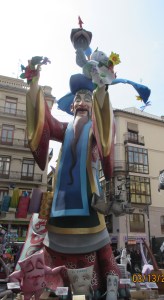
 originally made of cardboard, paper mache and wax; in recent years, they are constructed of light weight lumber, moldable cork and polystyrene. Each of Valencia’s neighborhoods erects at least one fallas, and typically two—the main one and a smaller one for children, called the infantil. (Walkin
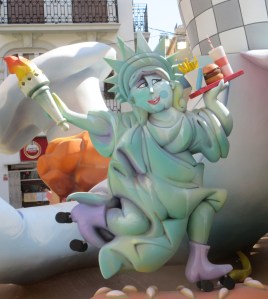 g around, it sometimes seems there is a giant lurking around every corner; there are nearly 400 fallas in the city itself.)
 cal, national and even international public figures.This year’s winning fallas (yes, this is a fiercely competitive exercise) espoused the idea that “everything is play-acting
 Stalin, Hitler,
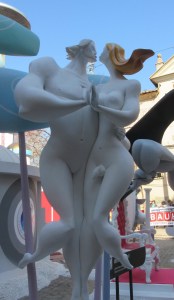 ented as fun-house mirrors, distorting the facts they reported. Even President Obama and global security interests got a ribbing.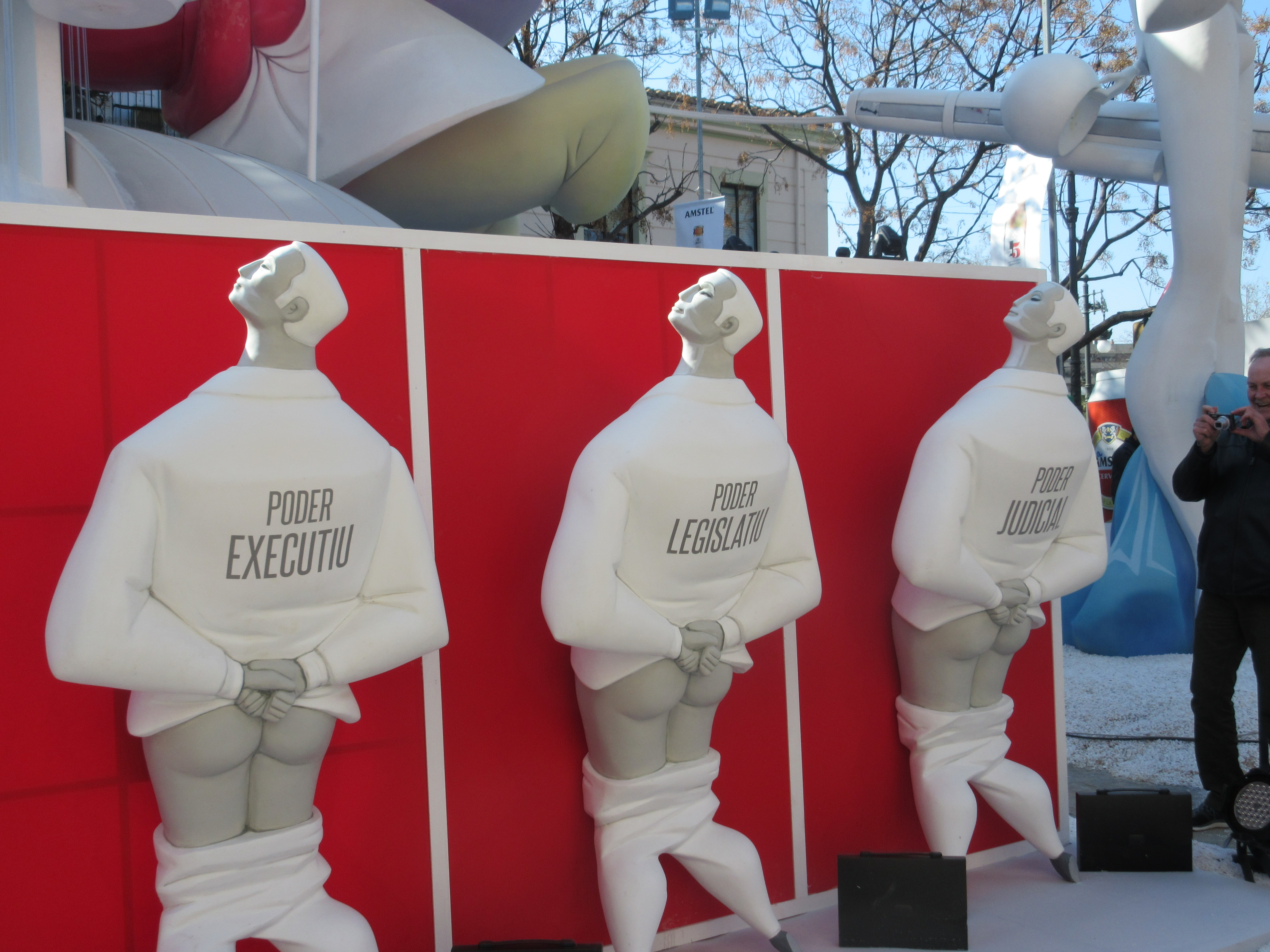
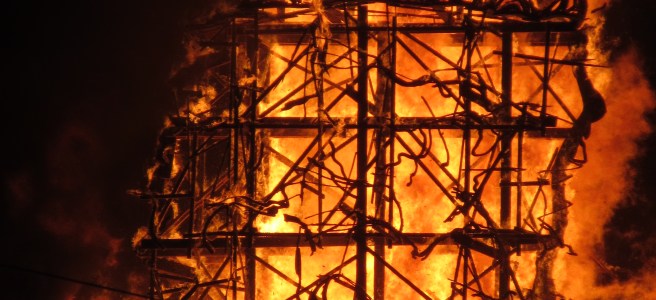
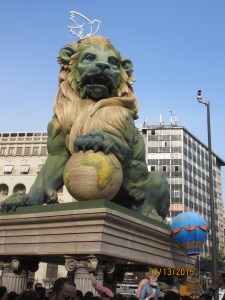 made entirely of flammable materials, because on the last night, the Nit de Cremá, a string of fireworks inside the monument is ignited and the structure is burned
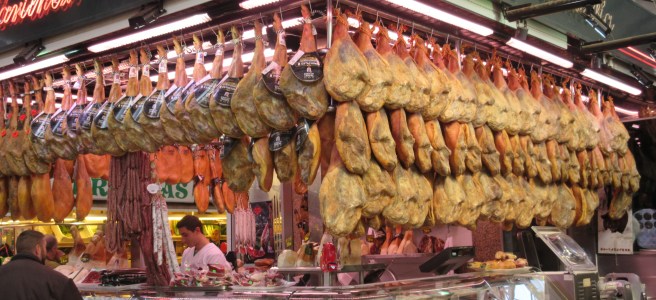
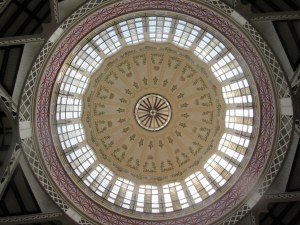 tile work. Light floods into the market from a huge central glass dome. And second, it’s filled with the most gorgeous and colorful fruits (fresh and dried), vegetables, herbs, spices and nuts you’ve ever seen. Huge pulpy red peppers. Fat bunches of freshly picked onions—fresh white globes with long green tops, like some kind of mutant scallion. Grapes nearly the size of golf balls. Piles of bright red strawberries that not only look delicious, but actually smell delicious, too. Mountains of sweet oranges. And strange fat pods of what I assume is some kind of bean.

 Piles of chicken feet. OK—maybe that’s not too weird: after all, you see them in Chinatown. But chicken heads? What on earth do you do with a pound or two of chicken heads? Chicken carcasses with the heads and feet still on them, as well as a few scattered feathers. Plus geese, ducks, partridges, quails and a variety of other game birds. Then, there’s the whole rabbits, with their milky eyes staring out of distressingly skinned rat-like faces. Pig’s feet. Pig’s ears. Pig’s everything. And the larger, darker red versions from cattle. Livers, of course. But also kidneys, lungs, hearts, brains, thyroids an
 d what seemed like more organs than exist in your average farm animal. Plus something that looked suspiciously like some animal’s penis, not to mention the whole heads—both pigs’ and calves’.
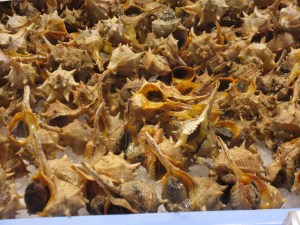 a general feeling of dampness. Counters are covered in the most amazing display of sea life outside an aquarium. Tiny fish, intended to be deep-fried whole and eaten. Whole and filleted slabs of larger fish, only some of which are recognizable.
  Spiny black sea urchins. Octopus and squid of various sizes and varieties. Teeny, tiny little soft-shelled clams and palm-sized oysters. Piles of at least a half dozen different creatures which I know must be some limb on the shrimp family tree but are unidentifiable. Buckets of wriggling eels. Even as I nearly gag thinking of swallowing some of this stuff, I can’t look away, amazed at the sheer variety and novelty of what’s before me.

 The Itinerant Retiree
