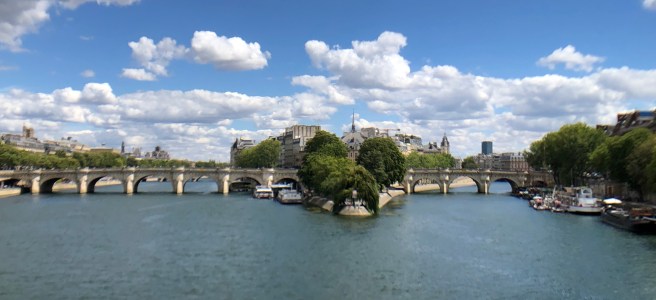
Paris is weird right now. At least that’s what the Parisians I met on my recent visit told me. It’s too quiet. There’s no buzz, no excitement. Doubtless that’s true. Certainly traffic at restaurants, hotels and stores has all but collapsed, first under strict stay-at-home rules to prevent the spread of the corona virus
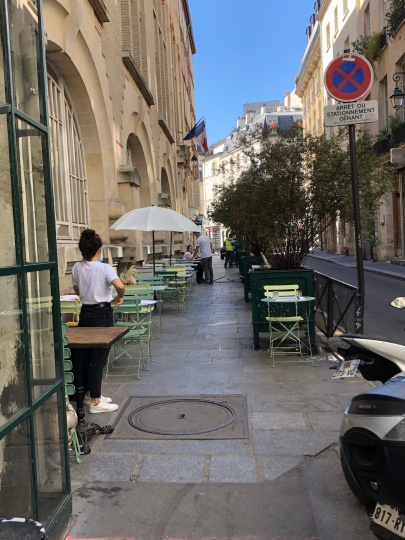
and now from the dearth of summer tourists. Theaters, large and small are dark. The big Paris l’été festival has been cancelled. Restaurants have largely closed their interior dining rooms and moved what tables they can outside. Traffic, both pedestrian and motorized, is scant, though bicycles and scooters are abundant.
But here’s the happy little secret: For those of us fortunate enough to be tourists in Paris in this bizarre summer, it’s fabulous.
The museums are open and blessedly uncrowded. All museums and monuments are requiring advance reservations, in order to enforce social distancing and hold attendance to just 50% of usual. But for the most part, the strictures are moot; there aren’t enough people requesting slots. I booked a reservation for the Louvre the
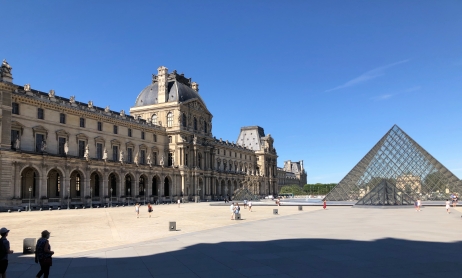
day before I wanted to go. It took no more than 5 minutes to get through the first ticket check and security. A year ago, I waited at least 40 minutes in last July’s heat wave to spend my allotted ten seconds in front of the Mona Lisa. This year, the line was minimal and guards were more relaxed about moving folks along. (Still, it wasn’t worth a second look, as the museum’s most popular exhibit rests behind glass and 20 feet away from viewers. I’d rather go gaze at the spectacular Winged Victory of Samothrace, instead.) The Orangerie, where Monet’s monumental water lilies panels are mounted, was nearly empty. So was the Marmotton Monet museum, with its special exhibit on Cezanne.
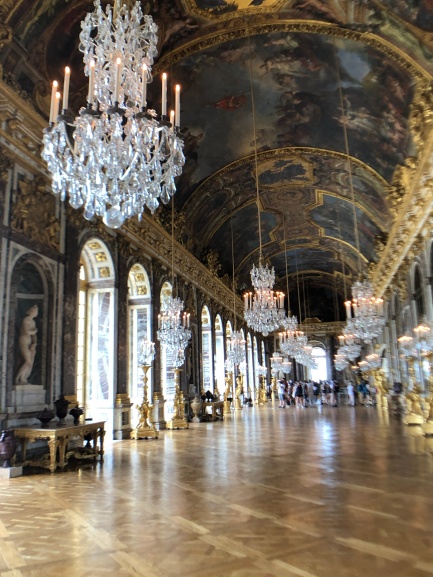
The longest I waited in line for anything, was about seven minutes, to get into a special exhibit of James Tissot’s work at the Musee D’Orsay. But that was on late-opening night, which usually attracts larger than usual
Another plus: Getting great photos was easy. I often end up not even taking pictures of places I’d like to remember because I hate photos with people in them. Especially people I don’t know, casually smoking a cigarette in the doorway of an elegant 18th century building or striding purposefully across an exquisite garden in shorts and a vulgarity-stewn T-shirt. This year: No problem!
But perhaps the best thing about visiting Paris in this strange year of Covid, was the slowed-down pace. Without having to worry about fixed time to visit a museum or wasting precious hours in lines or standing about waiting for a table at a café, I had
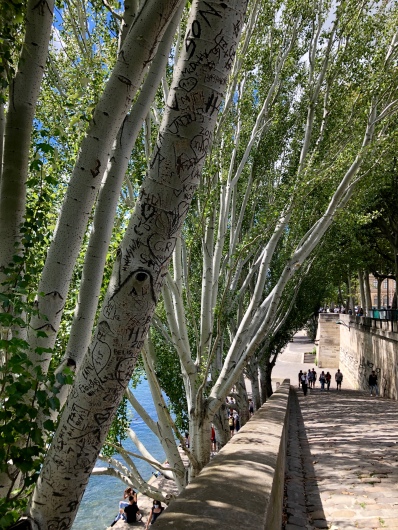
oodles of time to just relax and ramble through the city.
One day, I found myself in a district dotted with stores providing specialty cookery, pastry and candy making equipment. In retrospect, it made sense, as it was close to Les Halles, which until 1971 was Paris’s central fresh food market. The grand-daddy of the shops, E. Dehillerin’s feels more like an old-fashioned hardware store than an upscale cookware supplier. Its wooden floors creak and its few cramped aisles are crammed floor to ceiling with copper pots, brioche pans, fluted tartlet tins and the like. When you’ve found what you want (or asked for it), a shop assistant carefully takes your finds to an old wooden countertop and slowly and carefully wraps each item in paper. Once you’ve paid, you present him with the receipt and he hands over your new treasures. The minute I found the shop I knew: This was it! This was the Parisian shop where my sister must have found that perfect little wooden-handled angled spatula that I covet and she zealously protects. Eureka!
Another day, while meandering around looking casually for a cobbler who I might persuade to punch a new hole in shoe strap, I came upon Le Grand Café Tortoni.


Tucked away on a Marais street which seems to specialize in gentlemen’s tailoring, the 19thcentury shop is a wood, glass and marble step back in time. At one time a very successful and popular café and ice cream parlor, founded by an Italian gelato maker, it’s now home to a small café cum perfumerie, carrying scents, oils, lotions and so on from one of France’s oldest perfume makers. Officine Buly was founded in 1803 and revived after a century of sleep in 2014. I can’t tell you how good all the company’s dozen or so fragrances smell, since I went straight for the one with a name that conjured up the crisp, green scents I love: Scottish Lichen. It came home with me that day.
If you leave a little to serendipity, you’re sure to find delights in Paris: The last remaining puppet shop in the city on the Ile de St. Louis. Betrand’s, a bakery/café on the

left bank with a window full of the biggest, most colorful (and most delicious) meringues you can imagine. The fascinating exhibit hung on the protective fence around the construction site of Notre Dame, explaining how the cathedral’s structure is being carefully dismantled and/or shored up in preparation for eventual repairs. A tiny shop that specializes in beautifully made hand-forged Laguoile knives. The charming little house of an 18th century Italian rogue who convinced a gullible Bishop that he had cured him of asthma before the two were caught up in the infamous “affair of the necklace”, which helped turn the Paris populace against Marie Antoinette.
Oh, and by the way, Parisians are doing a great job complying with Covid health and sanitation measures. Every shop has hand sanitizer right at the door and shop assistants are vigilant about insisting customers use it. Ditto, mask use and limitations on how many people are in a small store at one time. About a quarter of the general population seems to be wearing masks walking in the streets or parks, but all put them on when entering a building or transit of any sort, and even when just standing at the bus stop. Hand sanitizers are everywhere, including stands at every bus stop and at the entrance to every Metro stop.





 us types sprinkle it with green. There’s a scrawny wildflower here and there, and what looks like some form of lichen creeping over and into some of the crags. At the Pr
 omenade du Peyrou, there’s another such boulder–this one with a small tree growing out of it–in the middle of a reflecting pool. A third boulder sits in a plaza fountain surrounded by outdoor cafés.
 One of the city’s largest and most famous public statues—the The Three Graces, sitting in the middle of the city’s Place du Comedie—incorporates a mound of natural rock, adorned both with chubby cherubs and scraggly plants. It’s unclear to me if the cherubs were carved from the rock or were somehow cemented into place. Either way, the juxtaposition of the formal statuary and the rough rock is, to my eye, at least, weird.
 es leading into country towns but sometimes what seem to be just random bits of road. They’re closely related to what we call sycamores in the U.S., and, well pruned, they form a beautiful high canopy. So why prune them to look like giant candelabras? They look strange and unnatural even when they’ve leafed out fully. When they’re bare, they’re ugly graceless things.
 Hereford cattle, is one which has been developed from a natural genetic mutation causing it to be hornless.) But when you pollard a tree, you don’t just lop off a limb or two. You shear every limb off every year, causing the tree to form large bulbous knobs.
 s? The result is a tree that at its best—for a few months in summer—looks like a ridiculous beach umbrella with a supersized center pole. At its worst—which is for the remaining two-thirds of the year—it looks like an arthritic troll: gnarled, knobby and disproportionate, with a trunk far too thick for its height.
 trees are simply sheared into conformity. We’ve all seen squared-off hedges. But full-grown trees? How do they even do that? I doubt I could make such a level cut on two-foot wide privet hedge. How do they evenly shear off a 30-foot wide, 40-foot high tree canopy?
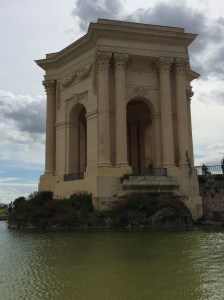 big litter-strewn gravel square, though it does lead up to the rather lovely classical Chateau D’Eau, which, coincidentally, sits on its own hunk of natural rock in a reflecting pool. At least in this case, though, the natural rock base is strewn with flowering plants. Incongruous perhaps, but pretty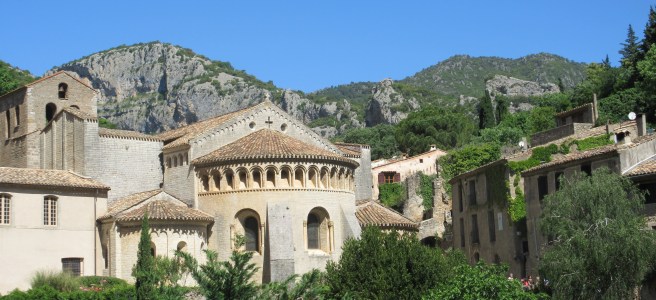
 th century, he was cousin and confidante to Charlemagne. Renowned as a warrior, he fiercely defended the southern borders of the Frankish empire, battling Gascons, Basques and Moors, ultimately forcing these last to retreat to Barcelona. Then he retired.
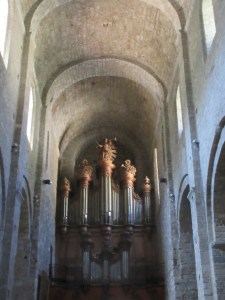 e abbey thrived, drawing pilgrims with two reliquaries: one containing the remains of the abbey’s famous founder; the other, several small pieces of wood, said to be part of the cross on which Jesus was crucified and given to Guilhem by Charlemagne. Indeed, the abbey became an important way station along
 one of the European routes to the shrine of St. James in Compostella, Spain. By the middle of the 11th century, the monks at Gellone Abbaye, now renamed the Abbaye de St. Guilhem, in honor of its recently canonized founder, were wealthy enough to build a new church and cloister.
 ation and pillaging. Abbots drawn from aristocratic families and named by the King, rather than elected by the monks themselves, allowed the vitality of the monastery’s enterprises to dwindle. During the 16th century religious wars, militant Protestants pillaged the abbey and defaced or destroyed much of the sculpture. By the French revolution, only six monks remained; the monastery was dissolved a
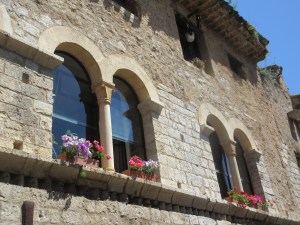 nd the buildings sold to a local stonemason, who carted off the stone for use in other buildings, peddling choice bits to wealthy clients. Eventually, parts of the abbey–columns, windows, statuary and more– wound
 up scattered across Europe. Some even came to rest across the Atlantic; several columns dating from around 1200, were purchased by a wealthy American collector. They’re now in New York’s Cloisters Museum.


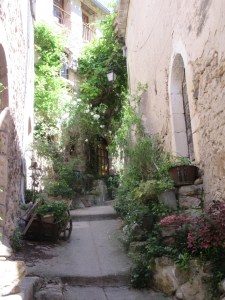
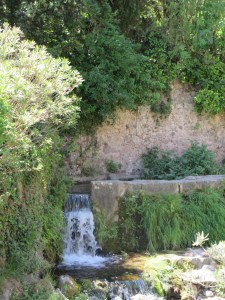 nning setting for the mellow old stone walls and tile roofs. Flowers bloom profusely in the sun. And everywhere there is the sound of running water—from the small rive
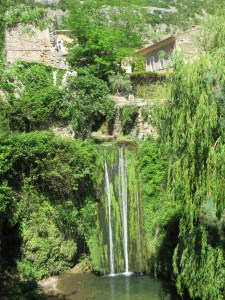 r that runs by the town, providing a series of picturesque waterfalls, as well as from the num
 erous spigots and fountains –flowing with potable water — scattered around the town. Even underfoot, clear water runs, criss-crossing the village in a series of open gullies and stone-topped drains.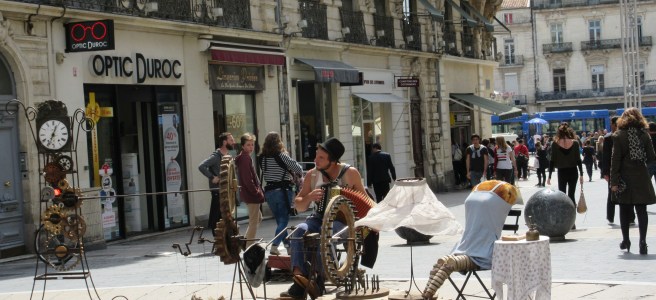
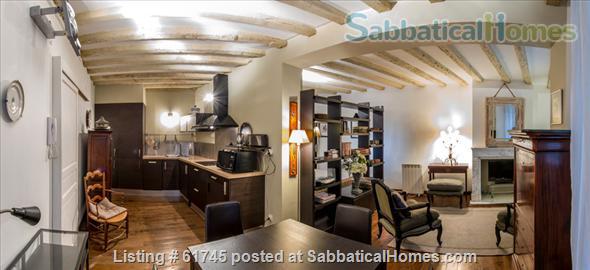
 can easily carry on a quiet conversation with the folks sitting at the café no more than 8 feet away, across the narrow street. In fact, the squeal made when you open the window shutters usually prompts most of the café’s patrons to turn and look. They nod hello and smile, and I adopt a rueful grimace and shrug an apology for the noise. At night, one draws closed the heavy wooden shutters and it’s pitch black inside the apartment. In fact, it’s still pitch black at midday the next day. If it weren’t for calls of nature, I might sleep right through from one evening to the next.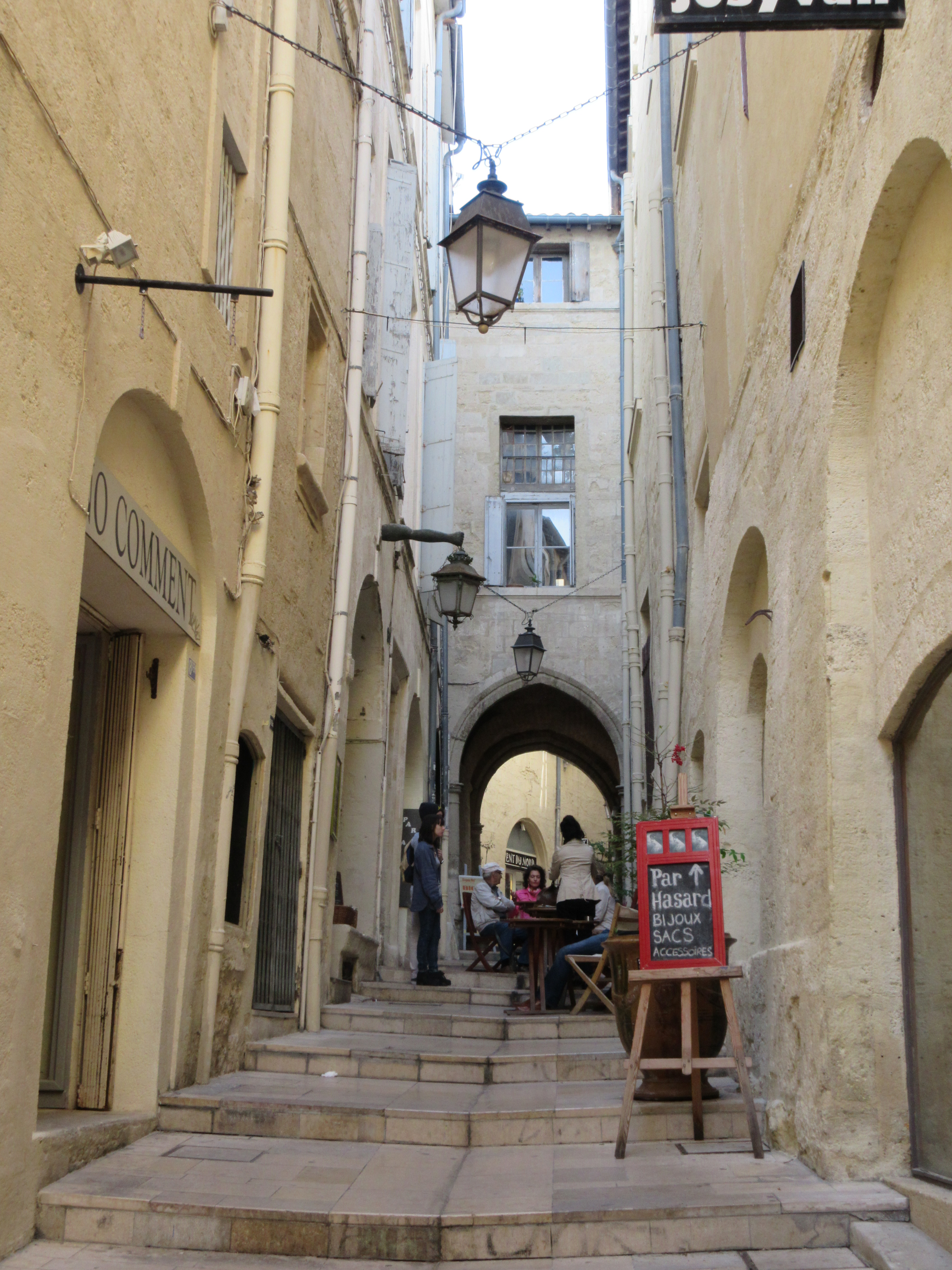



 But the prominence of Red Bull? That was unexpected, though maybe it shouldn’t have been. I didn’t realize that it was a European (Austrian) company. Slurping up sweet, super-caffeinated soft drinks seems so quintessentially American.



 The Itinerant Retiree