All things considered, phase one –the exploratory phase—of my itinerant retirement is going remarkably well. Which is not to say that there haven’t been some “oh shit” moments. So a little advice for anyone contemplating a similar adventure:
1. If you take a bus to a small town out in the countryside, make sure you know where to catch the only bus back.
The ride to Le Vigan, a small town on the edge of the Cevennes mountains was lovely. The goat cheese festival that drew me there, not bad, and I had a pleasant afternoon in the leafy park on the edge of town. I sampled some cheeses, lunched on grilled lamb and fresh salad, and dozed in the dappled sunshine. Edith Piaf recordings over a PA system alternated with lively and entertaining performances by the local band, it’s members clad in a dozen different iterations of striped shirts, pants and hats.
The bus making the journey back to Montpellier was scheduled to leave at 4:55, and I was waiting for it 10 minutes early. I wasn’t too concerned when it wasn’t there at 5:00. But by 5;15, I was pretty sure something was wrong. Up till then, every bus I’d taken had been smack on time. So in my fractured French, I asked a passing couple if they knew if the bus was ever this late. No, they answered in English. But the bus had already left, from the main stop in the town center. It didn’t come up to the final stop in the park on festival days. Some 60 euros poorer, I left the next morning, having spent the night at a local hotel and eaten an overpriced veal ragout for dinner. Still there was one plus: My hotel room had a tub and I got a nice long bath that night.
2. Always arrive at a new apartment with a stack of tissues in your luggage—especially if you arrive late at night or on a Sunday, when stores are closed. Apparently, you can’t count on a supply of toilet paper.
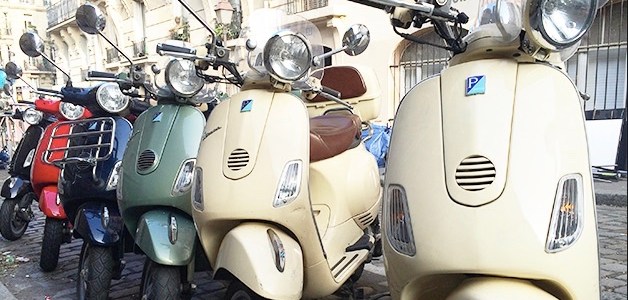
3. Do not overestimate your ability to learn new skills at age 62. I figured “how hard could it be to ride a motor scooter?” I should have been tipped off by the three grinning Frenchmen watching me from across the street as I climbed on for the first time. They’d clearly seen this drama unfolding before. I managed to wave jauntily to them and successfully traveled about 50 meters before I had to turn a corner. Down she went. I wasn’t hurt, fortunately, merely stuck under the tipped-over scooter and trying hard not to look embarrassed.
The young man who bounded over to help me up and right the scooter didn’t speak English, but he was pretty clearly saying “I don’t think this is a good idea”. I managed in a combination of Franglais and pantomime to convey that I wanted to get the scooter over into a nearby parking lot, where I could practice a bit more before taking it on the road. Reluctantly he wheeled it over, while making me promise “just one more try.” It wasn’t enough. This time, when the scooter went over, the side mirror broke and I called it quits. But I got to ride back to the shop on the back of the scooter, holding on to a cute French guy!
4. Do not order something based on a picture in a menu. It sure looked like a nice grilled piece of fish—something like tuna or swordfish. It tasted like cardboard and had the texture of a rubber boot. Sepia a la Planche turns out to be grilled cuttlefish—aka a chunk of a big squid. In fact, don’t eat at any restaurant that has pictures in its menus. It’s probably aimed at tourists who the proprietors figure wouldn’t know good food anyway and, in any case, won’t be back.
5. Ask which floor your AirBNB apartment is on. The first one –in Valencia—was four long flights up. It made me feel better about the volume of Spanish cheese and fresh bread I was eating, but reclimbing those stairs for a forgotten umbrella was torture. As for hauling 50 pound suitcases up and down? Oy. The second one, in Montpellier, was on the ground floor. Easy on the knees, not so good for letting in sunlight. And when the windows were open, you could reach out and pet any passing dogs (windows don’t have screens here.)
6. If you park in a garage, have cash, even if the signs say they take credit cards. Some of the self-pay kiosks don’t take credit or debit cards from outside the country you’re in. Note that French drivers are unbelievably impatient with anyone who holds up the exit lane figuring that out.
7. Watch out for those fruity wine drinks. The first time I ordered Aqua de Valencia, I thought it was a generous pitcher that I got, but what-the-heck, it ‘s just OJ with some cava (Spanish champagne) in it. It wasn’t until I tried to stand up (and later looked at the bill I’d signed) that I realized it had clearly been  meant for two people. And it wasn’t until a day or two later that I learned, no, it’s not just a bucket-sized Mimosa. Aqua de Valencia packs a potent punch of gin and vodka as well as the cava.
As for Sangria: Well, we Americans tend to think of it as a fruity summer drink for lightweights.. Take some red wine, add lemonade or fruit juice or club soda and a bunch of cut-up citrus fruit and you’ve got a nice, mild, refreshing summer drink. Not in Spain you don’t. Sangria here is red wine mixed with cava and brandy, with fruit soaked in enough brandy to preserve it for years. I had one; it was good. I had another and staggered out of the bar, forgetting to pay my bill.
8. Just let your hair grow. Despite checking for recommendations online, casing various stylists’ shops to see if the customers walked out looking good and happy, and even stopping total strangers in the street to ask where they got that really nice haircut, I ended up with some of the worst cuts I’ve ever had. In Malaga, the hair on one side of my head was a good 1/2 inch longer than on the other. And considering that the longest hair on my head was about 3 inches, it was quite a sight.
9. Watch where you step. Pooper-scoopers are apparently unheard of in many European cities. Ask me how I know.
10. If an AirBNB is described as “right in the center of things”, keep looking. My Malaga apartment was on the first floor (that’s up one from the ground floor in Europe) facing into what looked like a quiet little square a few blocks from Plaza Constitution, the main gathering place in the old quarter. Perfect, right? Wrong. At around 9 that first night, the doors on what had looked like shuttered residences on the ground floor were thrown open. Scores of tables and chairs filled the plaza and people began to gather. Hundreds of them And the party went on till at least 5 AM every night of the week except Mondays for the entire month I was there. No earplugs in the world could have deafened that noise of that crowd.


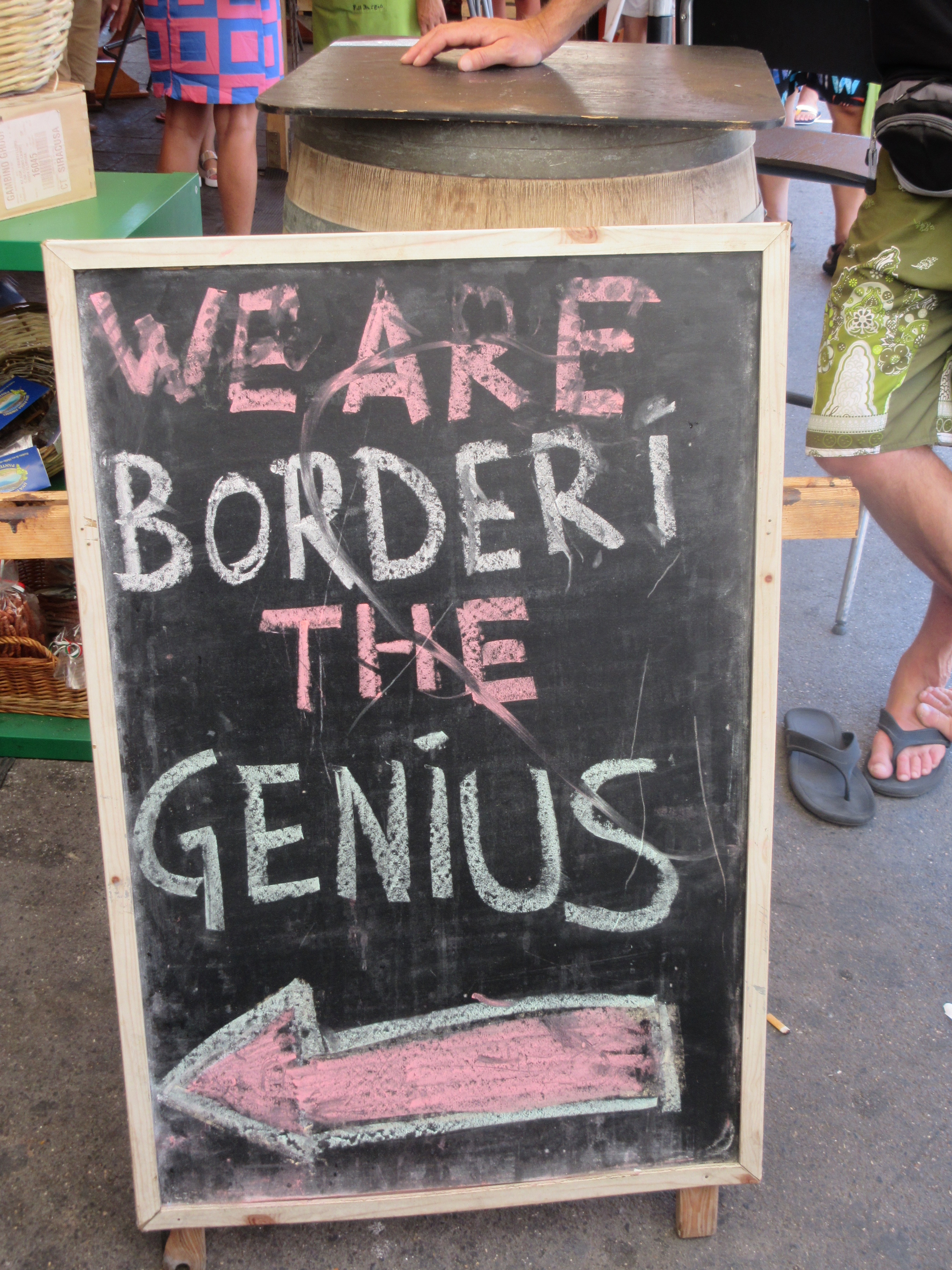
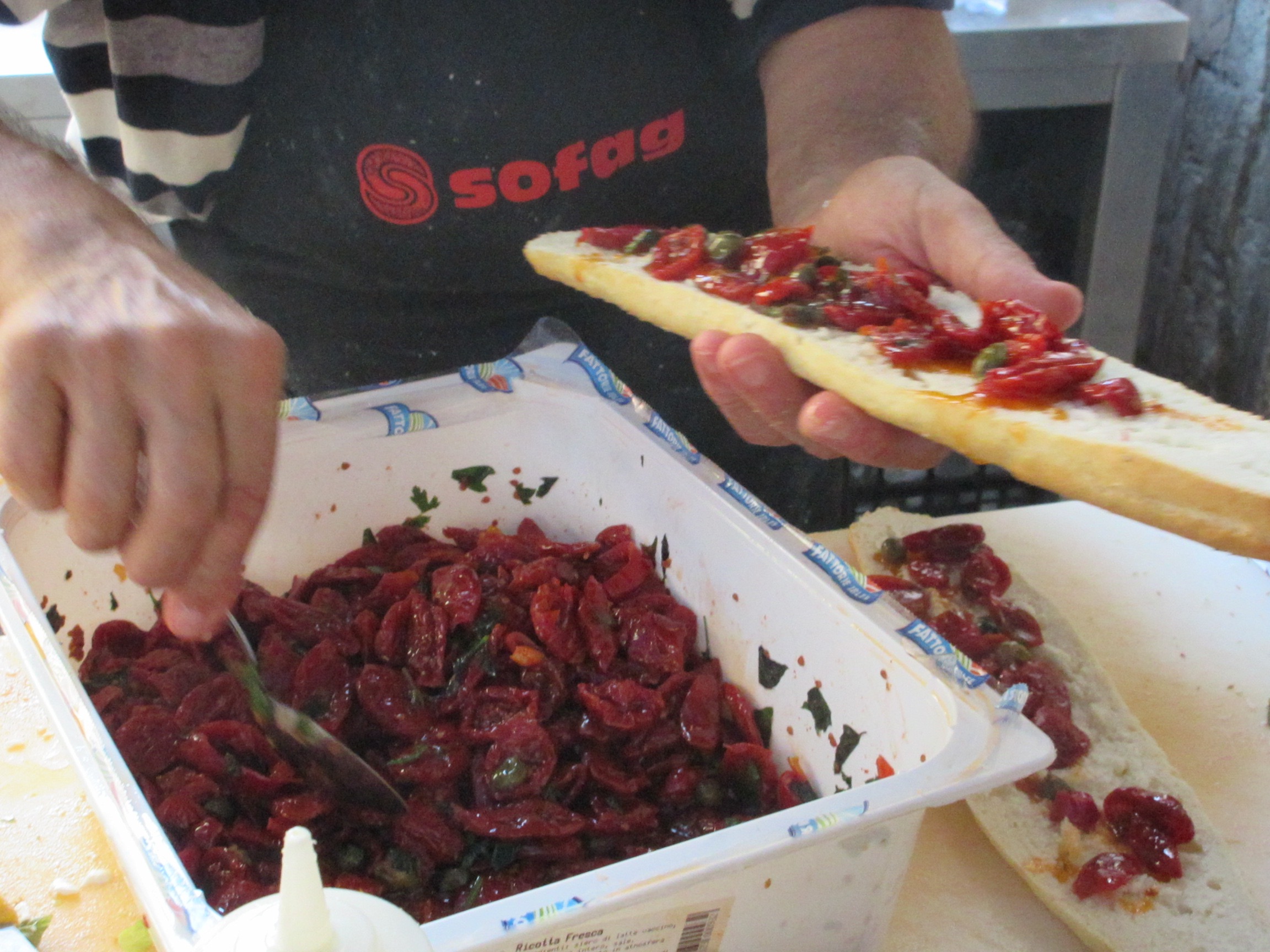
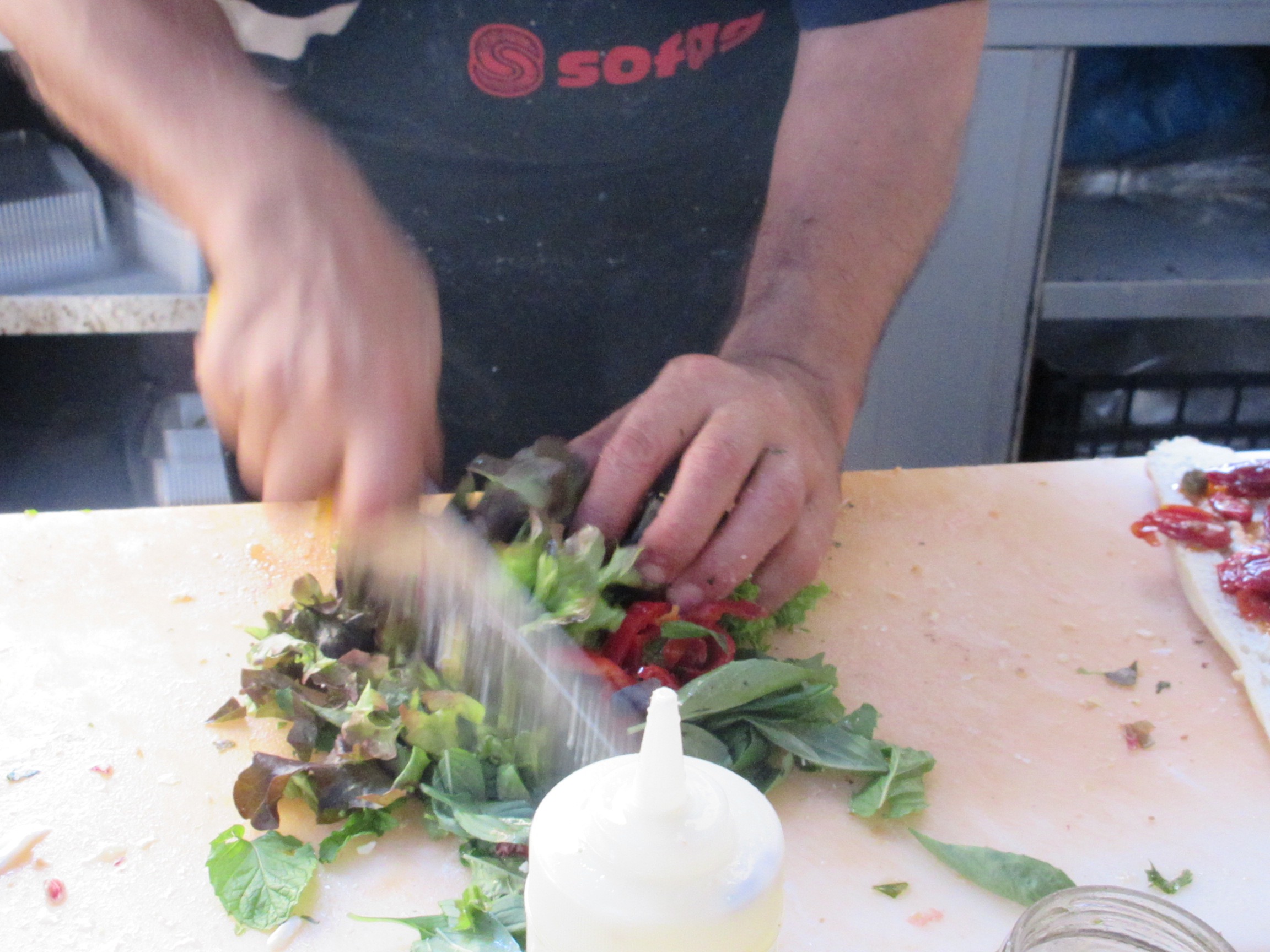
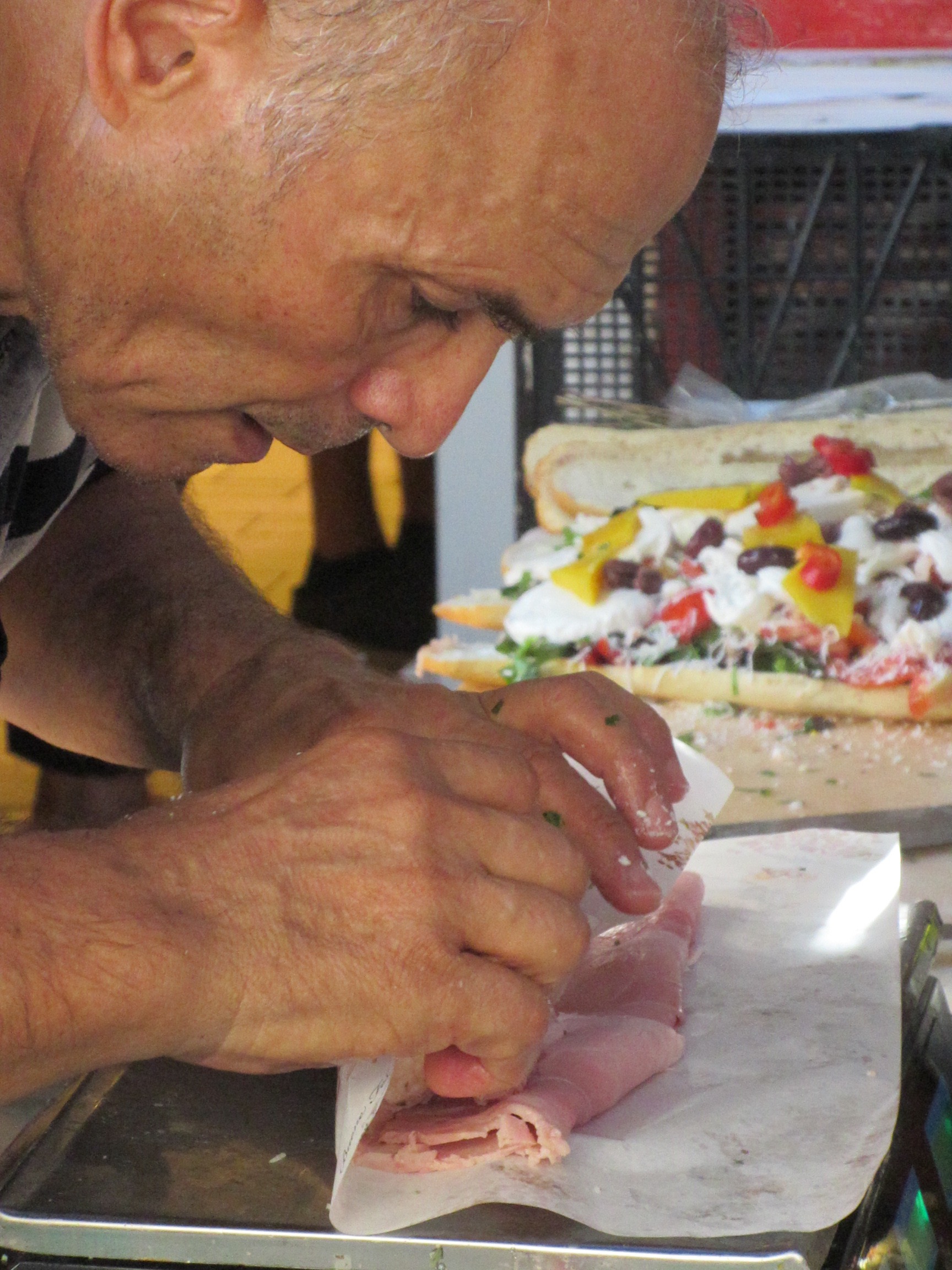
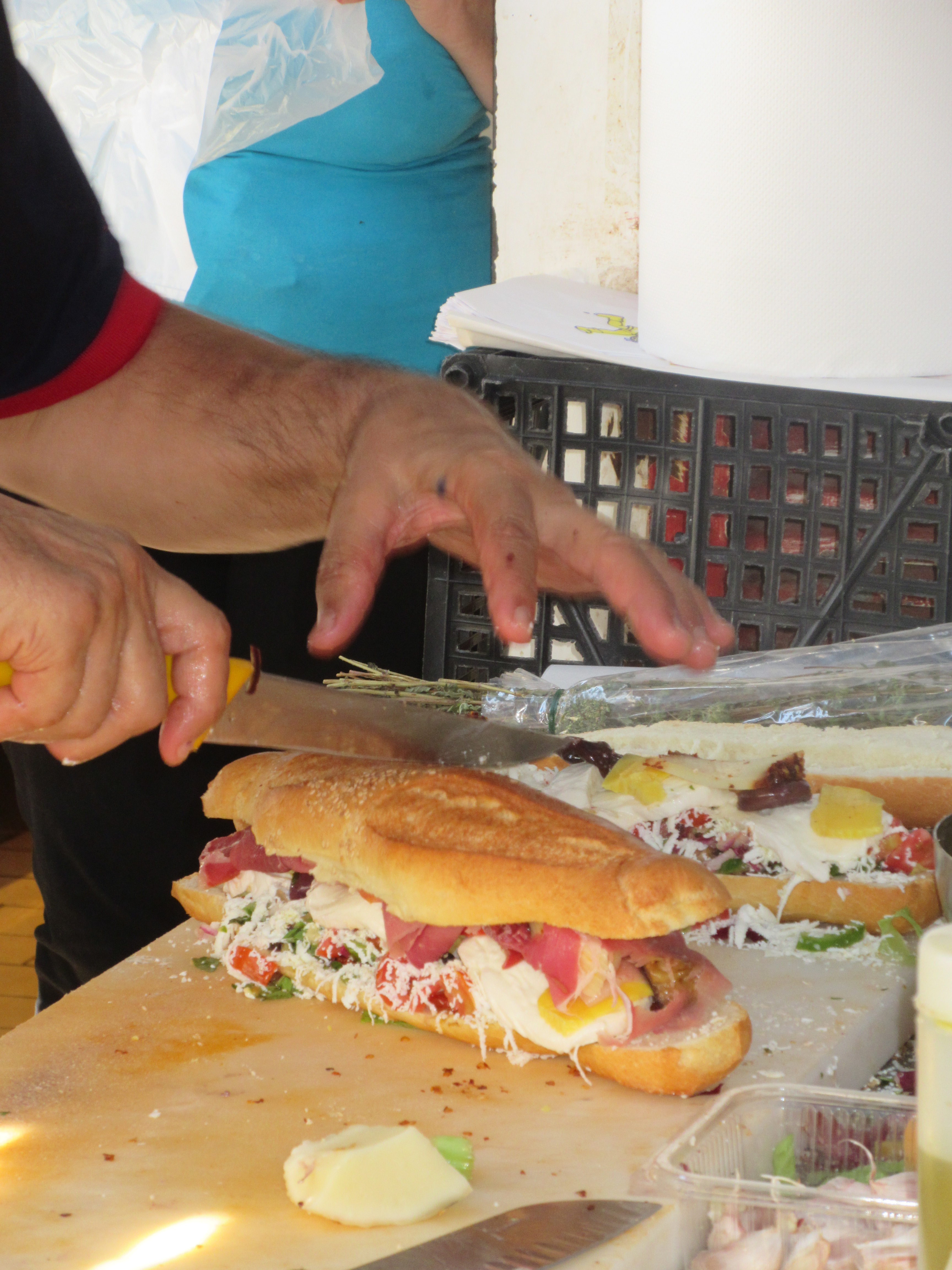
 Like other artists, Borderi has complete creative license. Customers don’t tell him what kind of sandwich they want. They simply tell him how many sandwiches they want and he takes it from there, drawing from his palette of meats, cheeses, vegetables and condiments as the moment’s fancy takes him. But the basic format remains the same.





 ll end up in the water. Those of you who know me well will recognize this as highly unusual behavior. I typically avoid occasions that require scanty clothing and don’t particularly like swimming either in pools or at beaches. But in Sicily it’s easy to leave behind the self-consciousness about dimply thighs, sagging boobs and ginormous butts. Women (and men) of all shapes, sizes and ages have no compunction about revealing far-from-perfect bodies—pasta-bellies and wrinkles be damned. (Of course, some of them do look pretty good!) I’ve even taken to wearing sleeveless tops in the only slightly cooler evenings, letting my usually camouflaged underams flap freely.
 In Syracuse, the homes aren’t wooden and are centuries older than the summer houses of Laurel Park, but they share a sort of casual summer shabbiness as well as the faint smell of mildew and damp, and typically inadequate, outdated and often jerry-rigged plumbing and electrical systems. And just as in my hometown, here wet swimsuits and threadbare towels hang outdoors on railings to dry; flip-flops are the footwear of choice for all ages; and meals are casual affairs, often eaten outdoors.
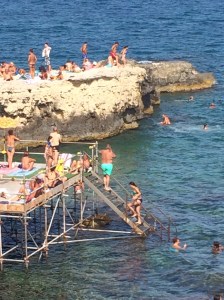 ed by a steep, fortress-like seawall, adding to the sense of Syracuse as a place with a long history of cultures repeatedly clashing and commingling. At one or two spots, long, steep staircases lead down to small sandy areas outside the seawall and a handful of tourists and locals spread their towels there to take in the sun and jump in the waves.





 us types sprinkle it with green. There’s a scrawny wildflower here and there, and what looks like some form of lichen creeping over and into some of the crags. At the Pr
 omenade du Peyrou, there’s another such boulder–this one with a small tree growing out of it–in the middle of a reflecting pool. A third boulder sits in a plaza fountain surrounded by outdoor cafés.
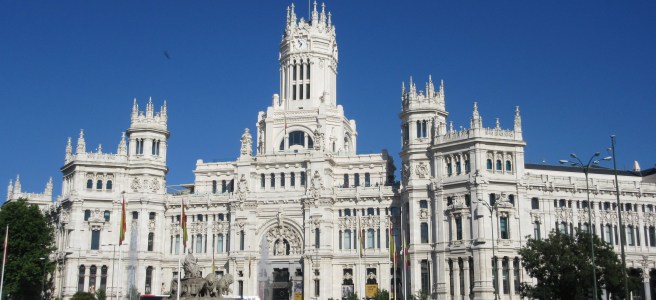
 One of the city’s largest and most famous public statues—the The Three Graces, sitting in the middle of the city’s Place du Comedie—incorporates a mound of natural rock, adorned both with chubby cherubs and scraggly plants. It’s unclear to me if the cherubs were carved from the rock or were somehow cemented into place. Either way, the juxtaposition of the formal statuary and the rough rock is, to my eye, at least, weird.
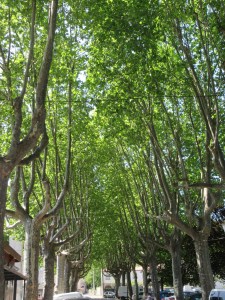 es leading into country towns but sometimes what seem to be just random bits of road. They’re closely related to what we call sycamores in the U.S., and, well pruned, they form a beautiful high canopy. So why prune them to look like giant candelabras? They look strange and unnatural even when they’ve leafed out fully. When they’re bare, they’re ugly graceless things.
 Hereford cattle, is one which has been developed from a natural genetic mutation causing it to be hornless.) But when you pollard a tree, you don’t just lop off a limb or two. You shear every limb off every year, causing the tree to form large bulbous knobs.
 s? The result is a tree that at its best—for a few months in summer—looks like a ridiculous beach umbrella with a supersized center pole. At its worst—which is for the remaining two-thirds of the year—it looks like an arthritic troll: gnarled, knobby and disproportionate, with a trunk far too thick for its height.
 trees are simply sheared into conformity. We’ve all seen squared-off hedges. But full-grown trees? How do they even do that? I doubt I could make such a level cut on two-foot wide privet hedge. How do they evenly shear off a 30-foot wide, 40-foot high tree canopy?
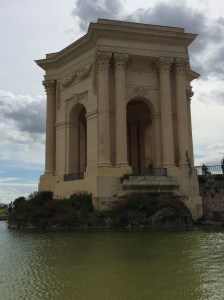 big litter-strewn gravel square, though it does lead up to the rather lovely classical Chateau D’Eau, which, coincidentally, sits on its own hunk of natural rock in a reflecting pool. At least in this case, though, the natural rock base is strewn with flowering plants. Incongruous perhaps, but pretty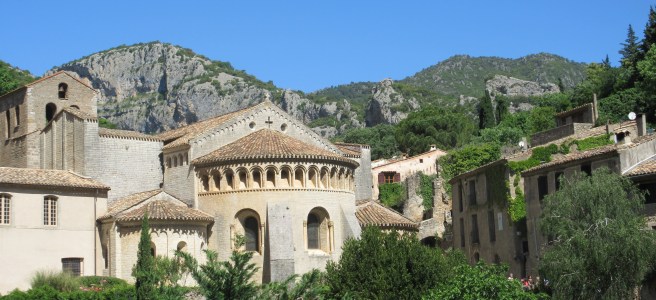
 th century, he was cousin and confidante to Charlemagne. Renowned as a warrior, he fiercely defended the southern borders of the Frankish empire, battling Gascons, Basques and Moors, ultimately forcing these last to retreat to Barcelona. Then he retired.
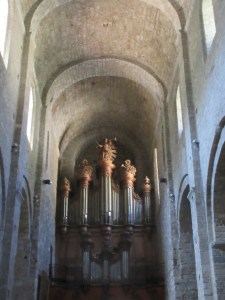 e abbey thrived, drawing pilgrims with two reliquaries: one containing the remains of the abbey’s famous founder; the other, several small pieces of wood, said to be part of the cross on which Jesus was crucified and given to Guilhem by Charlemagne. Indeed, the abbey became an important way station along
 one of the European routes to the shrine of St. James in Compostella, Spain. By the middle of the 11th century, the monks at Gellone Abbaye, now renamed the Abbaye de St. Guilhem, in honor of its recently canonized founder, were wealthy enough to build a new church and cloister.
 ation and pillaging. Abbots drawn from aristocratic families and named by the King, rather than elected by the monks themselves, allowed the vitality of the monastery’s enterprises to dwindle. During the 16th century religious wars, militant Protestants pillaged the abbey and defaced or destroyed much of the sculpture. By the French revolution, only six monks remained; the monastery was dissolved a
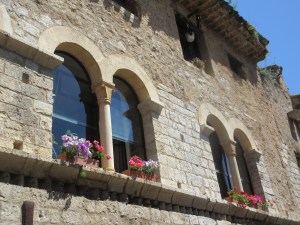 nd the buildings sold to a local stonemason, who carted off the stone for use in other buildings, peddling choice bits to wealthy clients. Eventually, parts of the abbey–columns, windows, statuary and more– wound
 up scattered across Europe. Some even came to rest across the Atlantic; several columns dating from around 1200, were purchased by a wealthy American collector. They’re now in New York’s Cloisters Museum.


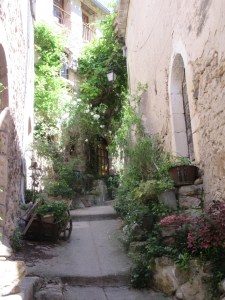
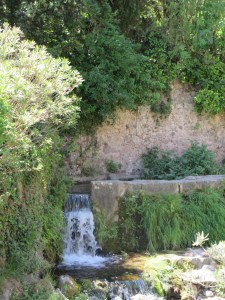 nning setting for the mellow old stone walls and tile roofs. Flowers bloom profusely in the sun. And everywhere there is the sound of running water—from the small rive
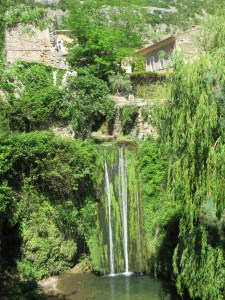 r that runs by the town, providing a series of picturesque waterfalls, as well as from the num
 erous spigots and fountains –flowing with potable water — scattered around the town. Even underfoot, clear water runs, criss-crossing the village in a series of open gullies and stone-topped drains.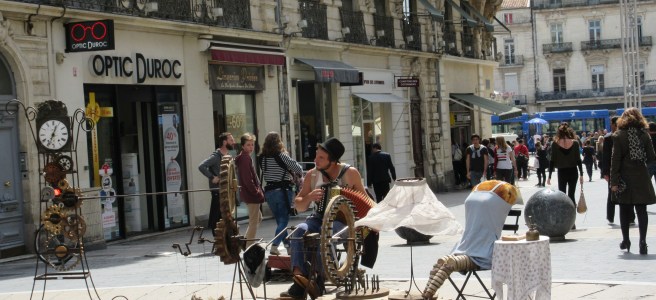

 can easily carry on a quiet conversation with the folks sitting at the café no more than 8 feet away, across the narrow street. In fact, the squeal made when you open the window shutters usually prompts most of the café’s patrons to turn and look. They nod hello and smile, and I adopt a rueful grimace and shrug an apology for the noise. At night, one draws closed the heavy wooden shutters and it’s pitch black inside the apartment. In fact, it’s still pitch black at midday the next day. If it weren’t for calls of nature, I might sleep right through from one evening to the next.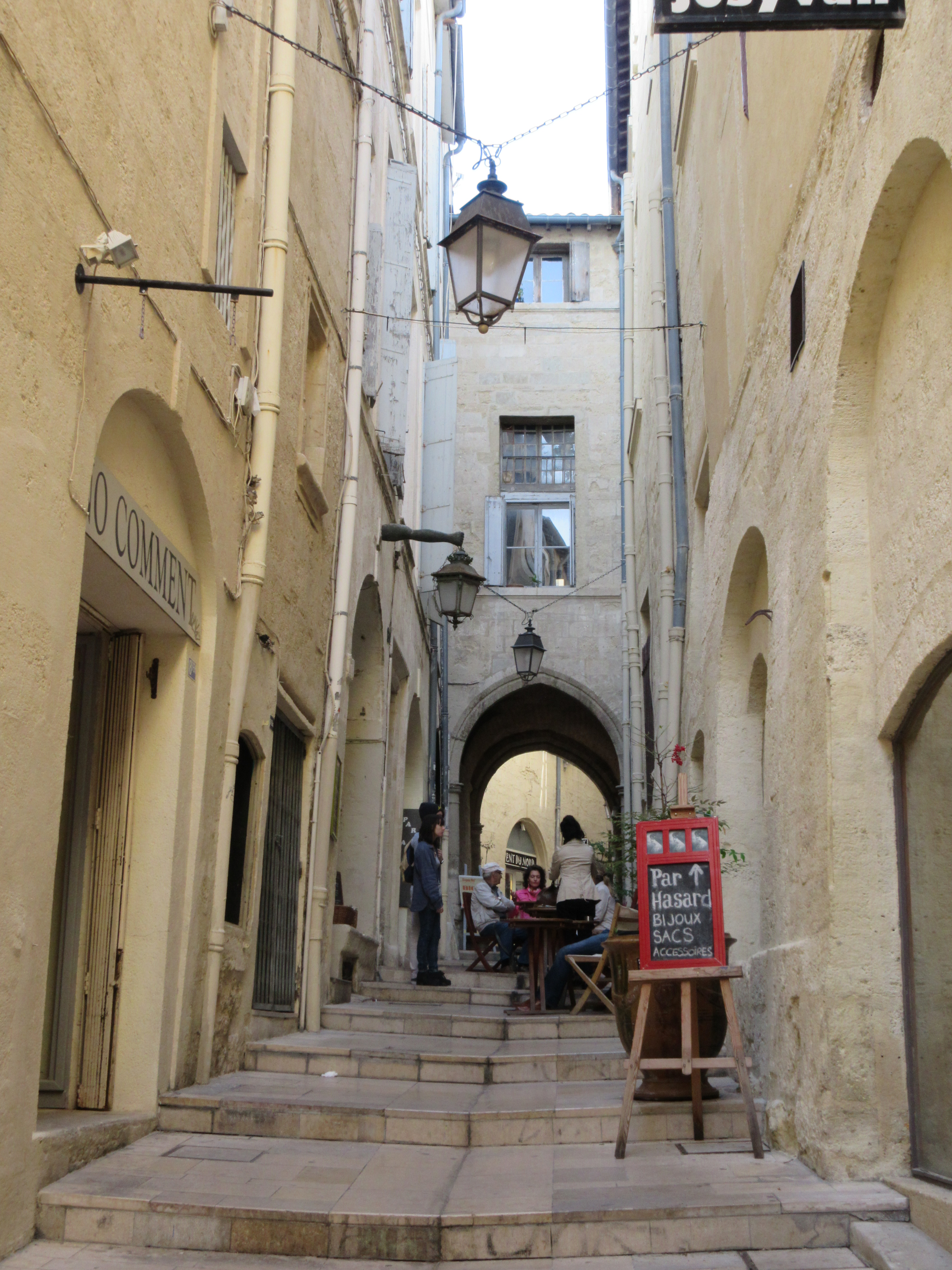

 ut there are other elements to impress visitors as well.
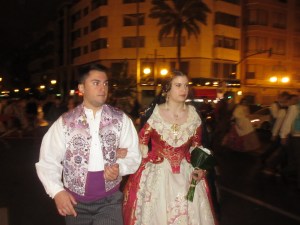 le some of the men wheel or carry huge floral arrangements. And by huge, I’m talking 6 or 7 feet wide and of a similar height.
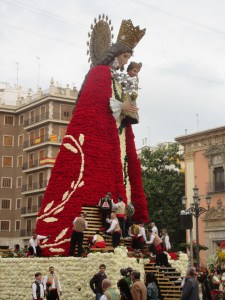 uilt into the statue 8 to 10 feet off the ground. That person tosses the flowers up to someone clinging to the wooden struts near the top of the statue. And he hands them to someone even higher up who wedges them into the structure, carefully following an elaborate red and white pattern that’s different each year.
 Meanwhile, the huge arrangements are massed together to the side and in front of the adjacent Bishops’ Palace. By the time all the flowers are in place on the 18th, the blocks surrounding the plaza are perfumed with their scent.
 y set off at the same time. There are times when you can see only a blur of light, there are so many going off at once. The Spanish also seem to like to set off rows of rockets that streak color from the ground up—sometimes crisscrossing in mid air—while simultaneously huge blossoms appear overhead. It’s a wonderful sort of chaos.
 lle Cuba and Calle Sueco are really something. Remember that Danny DeVito movie about the guy whose Christmas lights could be seen from space? He had nothing on the Ruzafa guys.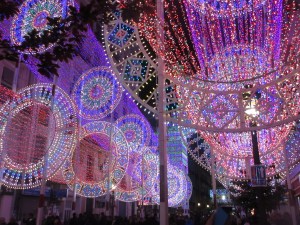
 The Itinerant Retiree